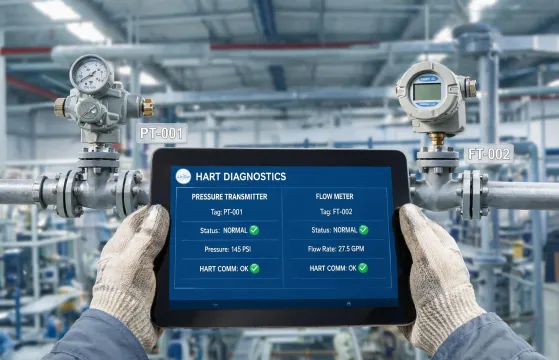
Signal integrity
4-20 mA, HART, IO-Link, and digital diagnostic paths are reviewed against cable runs, cabinet noise, PLC scaling, and alarm behavior so data reaches the control layer with fewer interpretation gaps.

Technology
Keyence technology work centers on the connection between field behavior and digital evidence. Smart sensors, HART-enabled transmitters, IO-Link diagnostics, metrology data, and laboratory imaging all create useful records only when the measurement chain is understood. The page follows the innovation-leader technology structure: gradient hero, horizontal technology pillars, accuracy statistics, trust evidence, and a focused CTA.
That approach matters because a dashboard cannot repair a poor installation, a sensor diagnostic cannot replace a calibration plan, and a laboratory image cannot prove a method unless the sample path is controlled. Keyence evaluates the instrument, the environment, and the record together so new technology improves decisions instead of adding another layer of unexplained data.
Technology Pillars
4-20 mA, HART, IO-Link, and digital diagnostic paths are reviewed against cable runs, cabinet noise, PLC scaling, and alarm behavior so data reaches the control layer with fewer interpretation gaps.
Accuracy statements are compared with temperature, vibration, corrosion, target changes, and service intervals. A ±0.1% of reading claim is useful only when the conditions behind it are visible.
Calibration plans name the reference chain, uncertainty, environmental conditions, and before-and-after data. Keyence uses NIST-traceable calibration language only for traceability, not as a product certification claim.
Microscopy, CMM, and handheld metrology tools are reviewed against repeatability, fixture access, operator method, and the image or measurement record required by quality teams.
These values are not decorative badges. They are prompts for asking whether response time, installed base experience, stated accuracy, and uncertainty reporting are relevant to the specific application being reviewed.




Send a process condition, inspection plan, or automation constraint. Keyence will help connect the technology choice to physical behavior, calibration evidence, and service expectations.
Discuss Technology Fit